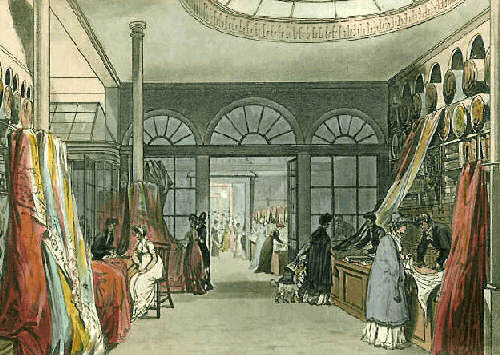
The sixteenth century English writer, Joseph Addison, stated: “Men have the sword, women have the fan and the fan is probably as effective a weapon!”
The Language of the Fan demonstrates the hidden language of the fan, an art that has been lost, but was once widely followed. Click here for a fascinating explanation.The Language of the Fan.

In Georgian England, women wore fans as a fashion accessory with almost every outfit that they owned. “There were daytime fans, white satin bridal fans and even mourning fans painted with grisaille, i.e. black, white and grey. Classical fans, brought from Italy, replaced the luscious rococo of the French. As well as drawing attention to beautiful and perfectly manicured hands, these items played a big part in delicate flirtations.”

Madame Devaucy, J.A.D. Ingres, 1807
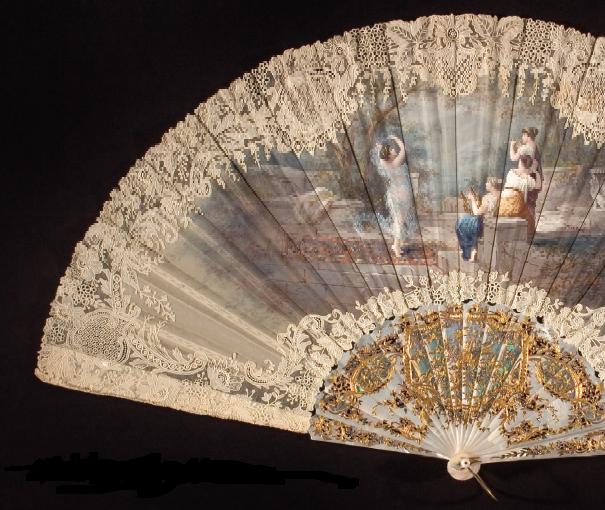 When one thinks of a fashionably attired Regency lady, one also thinks of the lovely fan she most likely carried. These graceful objects were first used for cooling, but during the 19th century they became an indispensable fashion accessory. Flirtations were carried on with fans, which hid blushing cheeks or communicated a specific message. (Click on ‘The Language of the Fan’ post below)
In the eighteenth century, wealthy Georgian ladies, especially English ones, waved [fans] at masquerade balls, and wore them as a fashion accessory with almost every outfit that they owned. There were daytime fans, white satin bridal fans and even mourning fans painted with grisaille, i.e. black, white and grey. Classical fans, brought from Italy, replaced the luscious rococo of the French. As well as drawing attention to beautiful and perfectly manicured hands, these items played a big part in delicate flirtations. In fact, a whole ‘language of the fan’ had developed in England in Tudor times which became especially popular for middle and upper-class Victorian women who were courting. A folded fan placed against a lady’s chin told a gentleman that she found him attractive, for example, while snapping a fan shut was a curt dismissal! No wonder that the sixteenth century English writer, Joseph Addison, stated: “Men have the sword, women have the fan and the fan is probably as effective a weapon!”- Life in Italy, Handheld Fans

The following passage was written in the U.S. in mid-nineteenth century America. It describes an oppressively hot day in church in which so many ladies were fanning themselves that they created a significant breeze for others. “One old lady must have been thinking of a dancing-tune to which her feet kept time in the days of her youth, as her fan kept time with a regular hop, skip and jump, not at all like any psalm-tune I ever heard.” The author goes on to describe fans made of red and yellow, or resembling a great palm-leaf, or made of a peacock’s tail or turkey feathers, their delicate ivory or sandalwood sticks and guards creating clicking sounds.
Those two young ladies who sit where side glances cross very conveniently from the crimson-cushioned pew occupied by a single gentleman, have consecrated theirs to the most effectual display of their ruby lips and laughing dimples, and I am kind enough to hope it will not be “all in vain,” and, as I have hinted, really think fans are often put to a worse use. No insignificant thing is the little flutterer, whatever may be its form or fashion – how many smiles and frowns and titters it hides, to say nothing of the blushes that take shelter behind its graceful folds. Many an ague fit have they given me; yet on the whole, I am not sure that I would banish them; were they the authors of ten times as much mischief, for I think it would cause a flutter among ladies, that would be more deleterious.
Into what a consternation they would be thrown if suddenly deprived of this relief in all embarrassments; and it is a curious fact, that in all heathen as well as all Christian nations, it is a favorite shield of the gentle sex. In all histories of queens and courts and festivals, the fan is conspicuous, whether it be among the Princes of Christendom, in India or China, or in the Islands of the seas. The true reason is that it is so graceful an appendage, and so kind a helpmeet in a moment of timidity or an hour of idleness.” -Minnie Myrtle, The Ladies and Their Fans, New York Times, June 30, 1854